Injection Wells in Athens County — Rally on March 18

Athens County Fracking Action Network (www.acfan.org)

COMMUNITY ADVOCATES CALL ON US-EPA
TO TAKE AWAY OHIO’S AUTHORITY OVER INJECTION WELL PROGRAM

Athens community advocates will hold a rally in front of the Athens County Courthouse on  Monday, March 18, at noon calling on US-EPA to investigate Ohio’s management of injection well regulation and to take away Ohio’s authority to regulate the program.

“Ohio Department of Natural Resources is not doing its job,” stated Grace Hall, member of Athens County Fracking Action Network, the event’s sponsor. “ODNR should be protecting Ohioans from carcinogenic, radioactive frack waste. Instead, it allows waste injection wells to operate for years after they have failed serious safety inspections.”

wells

Continue reading

Pro Publica: Injection Well Problems

Message from Mexico: U.S. Is Polluting Water It May Someday Need to Drink

by Abrahm Lustgarten ProPublica, Jan. 25, 2013, 8:49 a.m.

Mexico City plans to draw drinking water from a mile-deep aquifer, according to a report in the Los Angeles Times. The Mexican effort challenges a key tenet of U.S. clean water policy: that water far underground can be intentionally polluted because it will never be used.

U.S. environmental regulators have long assumed that reservoirs located thousands of feet underground will be too expensive to tap. So even as population increases, temperatures rise, and traditional water supplies dry up, American scientists and policy-makers often exempt these deep aquifers from clean water protections and allow energy and mining companies to inject pollutants directly into them.

As ProPublica has reported in an ongoing investigation about America’s management of its underground water, the U.S. Environmental Protection Agency has issued more than 1,500 permits for companies to pollute such aquifers in some of the driest regions. Frequently, the reason was that the water lies too deep to be worth protecting.

But Mexico City’s plans to tap its newly discovered aquifer suggest that America is poisoning wells it might need in the future.

Indeed, by the standard often applied in the U.S., American regulators could have allowed companies to pump pollutants into the aquifer beneath Mexico City.

For example, in eastern Wyoming, an analysis showed that it would cost half a million dollars to construct a water well into deep, but high-quality aquifer reserves. That, plus an untested assumption that all the deep layers below it could only contain poor-quality water, led regulators to allow a uranium mine to inject more than 200,000 gallons of toxic and radioactive waste every day into the underground reservoirs.

But south of the border, worsening water shortages have forced authorities to look ever deeper for drinking water.

Today in Mexico City, the world’s third-largest metropolis, the depletion of shallow reservoirs is causing the ground to sink in, iconic buildings to teeter, and underground infrastructure to crumble. The discovery of the previously unmapped deep reservoir could mean that water won’t have to be rationed or piped into Mexico City from hundreds of miles away.

According to the Times report, Mexican authorities have already drilled an exploratory well into the aquifer and are working to determine the exact size of the reservoir. They are prepared to spend as much as $40 million to pump and treat the deeper water, which they say could supply some of Mexico City’s 20 million people for as long as a century.

Scientists point to what’s happening in Mexico City as a harbinger of a world in which people will pay more and dig deeper to tap reserves of the one natural resource human beings simply cannot survive without.

“Around the world people are increasingly doing things that 50 years ago nobody would have said they’d do,” said Mike Wireman, a hydrogeologist with the EPA who also works with the World Bank on global water supply issues.

Wireman points to new research in Europe finding water reservoirs several miles beneath the surface u2014 far deeper than even the aquifer beneath Mexico City u2014 and says U.S. policy has been slow to adapt to this new understanding.

“Depth in and of itself does not guarantee anything u2014 it does not guarantee you won’t use it in the future, and it does not guarantee that that it is not” a source of drinking water, he said.

If Mexico City’s search for water seems extreme, it is not unusual. In aquifers Denver relies on, drinking water levels have dropped more than 300 feet. Texas rationed some water use last summer in the midst of a record-breaking drought. And Nevada u2014 realizing that the water levels in one of the nation’s largest reservoirs may soon drop below the intake pipes u2014 is building a drain hole to sap every last drop from the bottom.

“Water is limited, so they are really hustling to find other types of water,” said Mark Williams, a hydrologist at the University of Colorado at Boulder. “It’s kind of a grim future, there’s no two ways about it.”

In a parched world, Mexico City is sending a message: Deep, unknown potential sources of drinking water matter, and the U.S. pollutes them at its peril.

Permalink at Pro Publica: http://www.propublica.org/article/message-from-mexico-u.s.-is-polluting-water-it-may-someday-need-to-drink/single

Anti Fracking Concert

Jan. 25, 2013 10 PM-closing at Casa Nueva, 4 West State St., Athens

 Free admission. Donations encouraged to benefit

 Buckeye Forest Council and Appalachia Resist!

 Featuring

 – Broken Ring

 – Hunnabee & the Sandy Tar Boys

 – Sport Fishing USA

Hear great music by locally grown bands.
Hear brief but inspiring words from

  • Christine Hughes
  • Smiles Welch
  • Madeline ffitch

Come one. Come all. Bring family, friends, and neighbors, everyone you know who drinks water, breathes air, and loves the land.

And spread the word!

The Trillion-Gallon Loophole: Lax Rules for Drillers that Inject Pollutants Into the Earth

by Abrahm Lustgarten
republished from
ProPublica, Sept. 20, 2012, 12:12 p.m.

Injection Wells
The Hidden Risks of Pumping Waste Underground

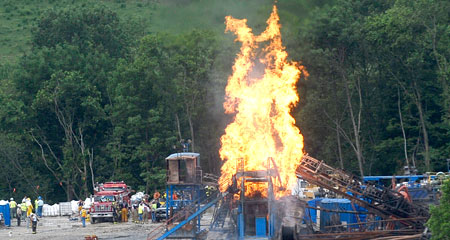
The remains of a tanker truck after an explosion ripped through an injection well site in a pasture outside of Rosharon, Texas, on Jan. 13, 2003, killing three workers. The fire occurred as two tanker trucks, including the one above, were unloading thousands of gallons of drilling wastewater. (Photo courtesy of the Chemical Safety Board)

On a cold, overcast afternoon in January 2003, two tanker trucks backed up to an injection well site in a pasture outside Rosharon, Texas. There, under a steel shed, they began to unload thousands of gallons of wastewater for burial deep beneath the earth.

The waste – the byproduct of oil and gas drilling – was described in regulatory documents as a benign mixture of salt and water. But as the liquid rushed from the trucks, it released a billowing vapor of far more volatile materials, including benzene and other flammable hydrocarbons. Continue reading

Update on Madeline ffitch

Court date has been changed for Madeline ffitch to October 3rd @2:30pm. We are still planning to have a big rally in front of the court house during her hearing. Big plans are forming, hope you can join us to help demand the Ginsburg well be shut down!

Fundraiser dinner, September 23rd 5-8:30 @ Purple Chopstix in Athens, to support the legal defense fund for Madeline. All local and/or organic ingredients, fabulous truffles from our very own, local chocolate shop, O’chocolate and much more! Please message Laura Post at https://www.facebook.com/messages/laura.post.90  if you’re interested in making a reservation and /or helping. Thank you!

New Injection Well Permit in Athens County?

Demand for Public Hearing

Press Release by the Athens (OH) County Fracking Action Network, acfan.org Sept. 12, 2012

A public notice for an Athens County injection well permit application for the Atha well on Rte. 144 near Frost, OH, has been posted.  Citizens have until Sept. 28 to send in comments and concerns about the application to the Ohio Department of Natural Resources (oilandgas@dnr.state.oh.us, include reference: Permit # 3761 and application # aAMY0000706). Continue reading

Madeline ffitch status conference at the Athens Court

By Nate Ebert, Spokesperson Appalachia Resist!
Release date: Sept 8, 2012

On September 7 the status conference for Madeline ffitch, the Athens County resident who faces a fifth degree felony charge for blocking a frack-waste injection well was held at the Athens County Courthouse.  The prosecution continued to ask that Madeline be disallowed from peacefully and legally participating in any Athens County anti-fracking protest, while counsel for the defense argued that this violates the defendant’s first amendment rights.  After the conference, Madeline and her legal counsel Bob Fitrakis made statements to press and supporters. Continue reading